


Why “Testosterone Boosters” Are Mostly Nonsense

Updated: Jul 23
Walk into any supplement store or scroll through any fitness influencer’s feed and you’ll see the same promise dressed up in a hundred different labels:
“Boost testosterone naturally.”
“Increase male vitality.”
“Restore your alpha edge.”
“Feel 25 again.”
Sounds good. Especially if you’re a man over 50 dealing with lower energy, softer muscle, stubborn belly fat, slower recovery, lower libido, or that general feeling of “I’m not firing like I used to.”
But here’s the truth:
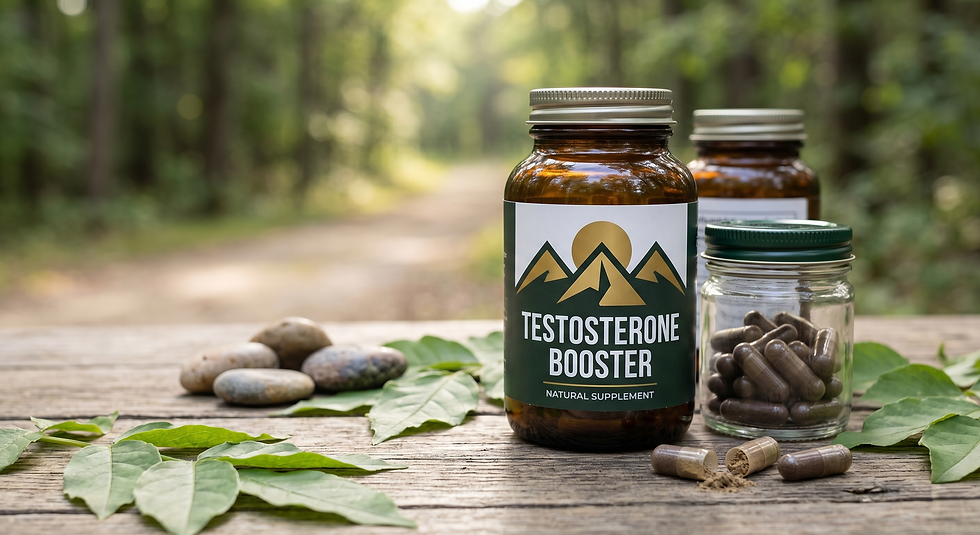
Most testosterone boosters are expensive confidence pills.
They sell the dream of higher testosterone, but most do very little — if anything — to meaningfully raise testosterone in healthy men.
And even when they do nudge a number on a lab test, that doesn’t always translate into more muscle, better sex, sharper drive, or improved performance.
Let’s break this down like grown men.
First: Testosterone Matters
Testosterone is not some vanity hormone.
For men, it plays a major role in:
Muscle mass and strength
Libido and sexual function
Mood and motivation
Red blood cell production
Bone density
Fat distribution
Recovery and energy
Confidence and drive
So yes, testosterone matters.
And yes, testosterone tends to decline with age. Starting around the 30s or 40s, many men experience a gradual drop. But the decline is not always dramatic, and it’s not always the root cause of every problem.
Low energy does not automatically mean low testosterone.
Low libido does not automatically mean low testosterone.
Belly fat does not automatically mean low testosterone.
Sometimes the problem is sleep deprivation. Sometimes it’s booze. Sometimes it’s stress. Sometimes it’s insulin resistance. Sometimes it’s depression. Sometimes it’s a bad marriage, a dead-end career, or living like a man who stopped training for life.
That’s why “just take this booster” is such a shallow answer.
The Supplement Industry Knows Exactly What Men Want
Testosterone marketing works because it hits men where they’re vulnerable.
Nobody wants to feel weak, tired, overweight, sexually flat, or past his prime.
So the industry sells a simple story:
“You feel off because your testosterone is low. Take this capsule and become yourself again.”
That story is powerful.
It’s also usually incomplete.
Most over-the-counter testosterone boosters rely on a handful of familiar ingredients:
Tribulus terrestris
Fenugreek
Ashwagandha
Tongkat ali
D-aspartic acid
Zinc
Magnesium
Vitamin D
Maca
Boron
Herbal blends with impressive names
Some of these compounds may have modest benefits in certain contexts. Some may help stress, sleep, libido, or nutrient deficiencies. But that’s not the same as meaningfully raising testosterone in a way that changes your body and life.
There’s a big difference between:
“This may slightly influence a hormone marker in some men”
and
“This will restore masculine performance.”
Most supplement labels blur that line on purpose.
The Big Problem: Boosters Usually Don’t Fix the Cause
If a man has low testosterone, you need to ask:
Why?
Testosterone can be affected by:
Poor sleep
Excess body fat
High alcohol intake
Chronic stress
Undereating or crash dieting
Low protein intake
Sedentary lifestyle
Overtraining
Sleep apnoea
Insulin resistance
Medications
Thyroid issues
Pituitary problems
Testicular dysfunction
Chronic inflammation
Nutrient deficiencies
A supplement does not magically override these.
If you’re sleeping five hours a night, drinking most evenings, carrying 30 extra pounds, barely lifting weights, and living under nonstop stress, a “testosterone booster” is not your solution.
That’s like putting racing stripes on a car with a blown engine.
You don’t need a better label.
You need a better operating system.
Tribulus: The Classic Example
Tribulus is one of the most famous testosterone booster ingredients.
It has been marketed for years as a natural testosterone enhancer. The problem? In most human studies, tribulus does not significantly raise testosterone in healthy men.
It may have some effect on libido for certain people, but libido and testosterone are not the same thing.
A supplement can make you feel a little more interested in sex without actually raising testosterone in a meaningful way.
That’s not necessarily useless — but it’s not what most men think they’re buying.
D-Aspartic Acid: Big Hype, Weak Follow-Through
D-aspartic acid had its moment.
Early research suggested it might increase testosterone, especially in men with lower baseline levels. Then more research came along and showed mixed results. In trained men, it often does little or nothing. In some cases, higher doses may even reduce testosterone.
This is common in supplement science.
One promising study becomes a marketing explosion. Then better or broader research shows the effect is smaller, inconsistent, or irrelevant for the average man.
But by then, the product has already sold millions.
Fenugreek, Ashwagandha, Tongkat Ali: More Interesting, Still Not Magic
Now, some ingredients deserve a more balanced look.
Fenugreek
Fenugreek may help libido and sexual function in some men. Some studies show small improvements in testosterone-related markers, but results vary. It is not a steroid. It is not testosterone replacement. It will not turn a tired, overweight, undertrained man into a savage.
Ashwagandha
Ashwagandha is better thought of as a stress and recovery supplement. It may reduce perceived stress and cortisol in some people. Since chronic stress can interfere with hormonal health, that can indirectly help.
Some studies show improvements in testosterone, especially in stressed or infertile men. But again, the effect is usually modest and context-dependent.
Tongkat Ali
Tongkat ali is one of the more interesting herbal options. Some research suggests it may improve libido, stress markers, and testosterone in men with low testosterone or high stress.
But quality matters. Dose matters. Extract matters. Your baseline health matters.
And the supplement industry often takes a potentially useful compound and buries it in an underdosed “proprietary blend” with a muscular name.
So is tongkat ali nonsense? Not necessarily.
Is it usually marketed with ridiculous overpromises? Absolutely.
The Nutrient Deficiency Trick
This is where testosterone booster companies get clever.
They include nutrients like:
Zinc
Magnesium
Vitamin D
These nutrients are genuinely important for testosterone production.
But here’s the catch:
They help most when you are deficient.
If you are low in vitamin D, correcting that deficiency may support healthier testosterone levels.
If you are zinc deficient, fixing that may help.
If you already have adequate levels, taking more usually won’t push your testosterone into superhero territory.
That’s like adding more oil to a car that already has enough oil. You don’t get more horsepower. You just waste oil.
Many “testosterone boosters” are basically multivitamins with attitude.
“Clinically Tested” Doesn’t Mean What You Think
Supplement companies love phrases like:
Clinically tested
Science-backed
Doctor formulated
Research supported
Shown to increase testosterone
These phrases can be technically true and still misleading.
A product may contain one ingredient that was used in one study.
The study may have been small.
The dose may be different.
The population may not match you.
The outcome may be statistically significant but practically meaningless.
For example, a supplement might increase testosterone by a small percentage, but not enough to noticeably affect strength, muscle, fat loss, mood, or libido.
A lab number can move without your life changing.
That matters.
Because you’re not trying to win a blood test. You’re trying to feel, perform, and live better.
Testosterone Is Not Just One Number
Another issue: many men don’t understand what they’re actually measuring.
When people talk about testosterone, they usually mean total testosterone. But that’s only part of the picture.

Important markers may include:
Total testosterone
Free testosterone
SHBG
LH and FSH
Oestradiol
Prolactin
Thyroid markers
Fasting insulin/glucose
CBC
Lipids
Liver enzymes
Vitamin D
A man can have normal total testosterone but low free testosterone because SHBG is high.
Another man can have low testosterone because his brain isn’t signalling properly.
Another may have low testosterone because his sleep apnoea is wrecking his hormones.
Another may have symptoms that have nothing to do with testosterone at all.
That’s why guessing with supplements is a poor strategy.
Test. Don’t guess.
The Lifestyle Levers Beat the Pills
If you want to support testosterone naturally, the boring stuff works best.
Not sexy.
Not marketable.
Not sold in a black bottle with flames on it.
But effective.
1. Sleep like it’s your job
Poor sleep crushes testosterone.
Most daily testosterone release is tied to sleep, especially deep sleep and REM sleep. If you’re sleeping five to six hours a night, your hormones are taking a hit.
Your first testosterone “booster” is 7–9 hours of quality sleep.
That means:
Consistent bedtime
Dark room
Cool room
No late-night alcohol
Less screen exposure before bed
Treat sleep apnoea if present
If you snore heavily, wake up choking, or feel exhausted despite a full night in bed, get evaluated for sleep apnoea. In men over 45, this is huge.
2. Lift heavy things
Resistance training is one of the best natural signals for maintaining muscle and hormonal health.
You don’t need to train like a 22-year-old bodybuilder.
But you do need to lift.
Focus on:
Squats or leg press
Deadlifts or hip hinges
Rows
Presses
Pull-ups or pulldowns
Carries
Core work
Build strength. Preserve muscle. Train with intent.
Muscle is not just for appearance. It is metabolic armour.
3. Lose the gut
Excess visceral fat is strongly linked with lower testosterone.
Belly fat is hormonally active tissue. It contributes to inflammation, insulin resistance, and altered sex hormone balance.
If your waist is climbing, your testosterone environment is probably getting worse.
A practical target:
Get your waist under half your height.
If you’re 5'10", that means aiming for a waist under about 35 inches.
Not everyone will hit that immediately, but it’s a strong direction.
4. Eat enough protein and real food
Low-quality diets hurt performance.
You want:
Protein at every meal
Whole foods most of the time
Enough healthy fats
Plenty of micronutrients
Fibre from plants
Minimal ultra-processed junk
For many men, a solid protein target is around:
0.7–1.0 grams per pound of goal body weight per day
If your goal weight is 190 pounds, that’s roughly 130–190 grams of protein daily.
You don’t need perfection. You need consistency.
5. Stop drinking like it doesn’t count
Alcohol is a major blind spot.
A couple drinks here and there? Fine for many men.
But regular heavy drinking can hurt sleep, liver function, body composition, mood, sexual performance, and testosterone.
The cruel part is that alcohol often makes men feel relaxed in the short term while quietly stealing the very energy and drive they’re trying to recover.
If you want better hormones, better sleep, and better sex, reduce alcohol.
Simple.
Not always easy.
But simple.
6. Manage stress like a grown man
Chronic stress is not just “in your head.”
It affects sleep, appetite, training recovery, blood pressure, glucose control, and sexual function.
You don’t need to become a monk.
You need outlets.
Walk daily
Train
Breathe slower
Spend time outside
Talk to someone
Set boundaries
Stop saying yes to everything
Fix the problems you keep numbing
A man under constant pressure with no recovery will eventually pay the bill.
When Testosterone Therapy Is Different
Over-the-counter boosters are not the same as medically supervised testosterone replacement therapy, or TRT.
TRT can be appropriate for men with clinically low testosterone and consistent symptoms, confirmed through proper testing.
But TRT is a medical decision. It requires monitoring and should not be treated like a casual wellness trend.
Potential considerations include:
Fertility suppression
Elevated red blood cell count
Acne or oily skin
Fluid retention
Changes in sleep apnoea
Prostate monitoring
Oestradiol balance
Cardiovascular risk assessment
Long-term commitment
TRT can be life-changing for the right man.
It can also be misused by men who never addressed sleep, fat loss, stress, alcohol, or training.
The goal is not to be “on testosterone.”
The goal is to be healthy, capable, strong, clear-headed, and dangerous in the best sense of the word.
So Are All Testosterone Boosters Useless?
No. That would be too simplistic.
Some supplements may help if they address a real issue.
Examples:
Vitamin D if you’re deficient
Zinc if you’re deficient
Magnesium if your intake is low
Ashwagandha if stress is high and you tolerate it well
Tongkat Ali in certain men, depending on quality and baseline levels
Creatine for strength, muscle, and performance — though it is not a testosterone booster
But most testosterone booster stacks are overhyped, underdosed, and marketed far beyond the evidence.
The smarter question is not:
“What supplement boosts testosterone?”
The smarter question is:
“What is suppressing my testosterone or performance in the first place?”
That’s where the answers live.
The Real Testosterone Booster Stack
If I were building a “testosterone booster” for men over 50, it would look like this:
Morning
Wake at a consistent time
Get sunlight early
Eat protein
Move your body
Training
Lift 3–4 days per week
Walk daily
Do some conditioning
Avoid living in either laziness or overtraining
Nutrition
Protein every meal
Mostly whole foods
Enough calories, not crash dieting
Keep waist size under control
Limit alcohol
Recovery
Sleep 7–9 hours
Treat snoring or sleep apnoea
Manage stress
Take rest days seriously
Testing
Check total and free testosterone
Look at SHBG, LH, FSH, oestradiol, prolactin when appropriate
Assess metabolic health
Work with a qualified clinician
That stack is not flashy.
But it works better than 95% of the nonsense being sold online.
The Bottom Line
Most testosterone boosters are nonsense because they sell a shortcut around the fundamentals.
They promise power without discipline.
They offer masculinity in a bottle.
They target insecurity and wrap it in “science-backed” language.
But if you’re a man over 50, you don’t need fairy dust. You need truth.
If your testosterone is truly low, get proper bloodwork and work with a clinician.
If your lifestyle is crushing your hormones, fix the lifestyle.
If you’re deficient in something, correct it.
If you need medical treatment, take that seriously.
But don’t fall for the idea that a $69 bottle of herbs is going to undo years of poor sleep, stress, alcohol, belly fat, and missed workouts.
You don’t rebuild a man with a capsule.
You rebuild him with standards.


Comments