


Get Your Sleep Right: The 50TOUGH Man’s Guide to Better Recovery, Hormones, Focus, and Discipline

Updated: Jul 23
A lot of men over 50 treat sleep like it’s optional.
They’ll train hard, work long hours, eat cleaner, take supplements, push through stress — but still run on five or six broken hours a night and wonder why their body feels older than it should.
Here’s the truth:
Sleep is not weakness. Sleep is your recovery weapon.
It’s when your brain cleans house, your hormones recalibrate, your muscles repair, your immune system reloads, and your nervous system gets out of “fight mode.” If you want to be strong, sharp, lean, patient, productive, and dangerous in the best possible way — you need to get your sleep right.
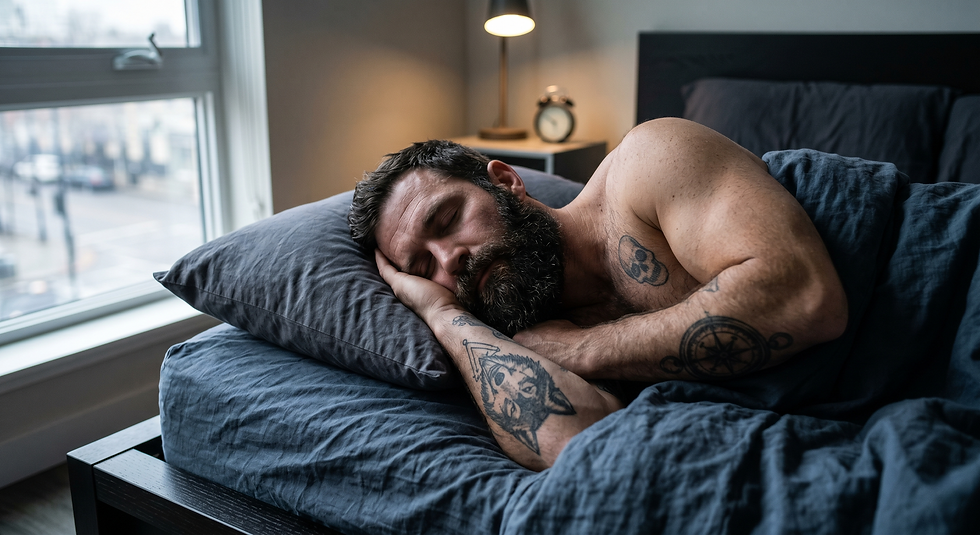
Why Sleep Matters More After 50
When you’re younger, you can get away with more abuse. Late nights. Alcohol. Stress. Bad food. Weird schedules.
After 50, the bill comes due faster.
Poor sleep hits harder because many men are already dealing with:
Lower testosterone compared to younger years
More stress load from career, family, money, and responsibilities
Slower recovery from training
Higher risk of blood pressure, insulin resistance, and inflammation
More night-time urination
More snoring and possible sleep apnoea
Joint pain, reflux, or stress-driven wakeups
So if your sleep is off, everything else becomes harder.
What Lack of Sleep Does to the Body
1. It Crushes Testosterone and Hormonal Health
Sleep is deeply tied to testosterone production. In one well-known study published in JAMA, healthy young men restricted to five hours of sleep per night for one week had a significant drop in daytime testosterone levels.
Now, if that happens to younger men, imagine what it can do to a man over 50 who is already fighting age-related hormonal decline.
Poor sleep may contribute to:
Lower testosterone
Lower libido
Reduced morning erections
Less muscle-building capacity
Worse mood and motivation
More belly fat accumulation
Sleep is one of the most underrated testosterone-supporting habits on the planet.
2. It Wrecks Fat Loss and Increases Hunger
When you sleep poorly, your hunger hormones get thrown off.
Research from the University of Chicago showed that sleep restriction can increase ghrelin, the “I’m hungry” hormone, and decrease leptin, the “I’m full” hormone.
Translation:
You crave more food, especially junk food, and you feel less satisfied when you eat.
That’s why a tired man doesn’t crave salmon and broccoli at 9:30 p.m. He wants chips, cookies, bourbon, cereal, or whatever is easy and salty.
Poor sleep makes discipline more expensive.
3. It Increases Insulin Resistance
Sleep loss can make your body worse at handling blood sugar.
Studies show that even short-term sleep restriction can reduce insulin sensitivity. That means your body has a harder time moving glucose out of the bloodstream and into the muscles where it belongs.
Over time, poor sleep may increase risk for:
Prediabetes
Type 2 diabetes
Belly fat
Energy crashes
Brain fog
Cravings
Cardiovascular disease
If you’re training and eating well but your waistline won’t move, look at your sleep.
4. It Hurts the Heart
Poor sleep is associated with higher risk of hypertension, coronary artery disease, stroke, and arrhythmias.
One major issue is that lack of sleep keeps the sympathetic nervous system fired up. That’s your “fight or flight” system. It raises stress hormones, blood pressure, and inflammation.
Your heart is not designed to be in battle mode 24/7.
Good sleep gives your cardiovascular system a nightly reset.
5. It Weakens the Immune System
Sleep helps regulate immune function. In one study published in Archives of Internal Medicine, people who slept less than seven hours per night were nearly three times more likely to develop a cold after being exposed to a virus compared to those who slept eight hours or more.
Poor sleep can leave you more vulnerable to:
Colds and viruses
Slower healing
Higher inflammation
Poor recovery from hard training
More aches and pains
You don’t tough your way through a weak immune system. You rebuild it.
6. It Makes You Irritable, Foggy, and Less Resilient
Sleep deprivation changes your brain.
Your prefrontal cortex — the part responsible for decision-making, emotional control, judgment, and discipline — gets weaker when you’re tired.
Meanwhile, your emotional threat system gets louder.
That means you become:
More reactive
Less patient
More anxious
More negative
Less focused
More likely to quit on good habits
More likely to snap at people you care about
A tired man is not the best version of himself. He’s a more fragile version.
The Big Warning Sign: Sleep Apnoea
Men over 50 need to take this seriously.
If you snore loudly, wake up gasping, feel tired after “enough” sleep, have morning headaches, high blood pressure, or your partner says you stop breathing at night — get evaluated for sleep apnoea.
Sleep apnoea is not just annoying snoring. It is repeated oxygen deprivation during sleep.
Untreated sleep apnoea is linked to:
High blood pressure
Atrial fibrillation
Heart disease
Stroke risk
Low testosterone
Erectile dysfunction
Daytime fatigue
Brain fog
Mood issues
If you suspect it, don’t macho-man your way around it. Get a sleep study.
The 50TOUGH Sleep Protocol
Here’s how to start fixing it.
1. Set a Non-Negotiable Wake Time
Most men obsess over bedtime. Start with wake time.
Pick a wake time and hold it steady, even on weekends as much as possible.
Why?
Your body runs on a circadian rhythm — an internal clock. A consistent wake time anchors that clock.
Goal: Wake within the same 30–60 minute window daily.
If you’re all over the place — 5:30 a.m. weekdays, 8:30 a.m. weekends — your body feels like it’s changing time zones every week.
2. Get Morning Sunlight
This is one of the most powerful sleep tools, and it’s free.
Get outside within the first hour of waking. No sunglasses if possible. Don’t stare at the sun — just get natural light into your eyes.
Morning light helps set your circadian rhythm and tells your brain: “Day has started.”
That makes it easier for your body to release melatonin later at night.
Target: 10–20 minutes outside in the morning. More if it’s cloudy.
3. Cut Caffeine Earlier Than You Think
Caffeine has a half-life of roughly 5–6 hours, but for some men it lingers longer.
That 2 p.m. coffee may still be affecting your nervous system at 10 p.m.
If your sleep is poor, set a hard caffeine cut-off.
Rule: No caffeine after 10 a.m. to noon.
Also remember caffeine hides in:
Pre-workout drinks
Energy drinks
Green tea
Chocolate
Some fat burners
Certain headache medications
If you “can drink coffee at night and still sleep,” you may fall asleep — but your sleep quality can still be worse.
4. Stop Using Alcohol as a Sleep Aid
Alcohol may help you pass out, but it damages sleep quality.
It reduces REM sleep, fragments sleep, increases night-time wakeups, worsens snoring, and can aggravate sleep apnoea.
This is why you may sleep eight hours after drinking and still wake up feeling like a bag of hammers.
50TOUGH rule: If sleep quality matters, alcohol has to be limited — especially within 3–4 hours of bedtime.
5. Cool the Room Down
Your body temperature needs to drop to initiate and maintain good sleep.
A hot room fights that process.
Target: Around 60–67°F (15.6 - 19.4 Celsius) if tolerable.
Other tactics:
Use breathable bedding
Take a warm shower 60–90 minutes before bed
Keep feet warm if needed
Use a fan for airflow and white noise
A warm shower seems backwards, but it can help because your body releases heat afterward, helping your core temperature drop.
6. Build a Shutdown Routine
Most men don’t have a sleep problem. They have a shutdown problem.
They run full-speed all day, stare at screens at night, answer emails, watch intense shows, scroll political chaos, then expect their brain to power down like flipping a switch.
That’s not how the nervous system works.
Create a 30–60 minute wind-down routine.
Example:
Lights dimmed
Phone away or on night mode
No work email
Light stretching
Hot shower
Read fiction or something calming
Journal tomorrow’s tasks
Breathwork for 5 minutes
Bed
You’re training your body to recognise the pattern: “It’s time to power down.”
7. Protect the Bedroom
Your bedroom should be a sleep cave.
Make it:
Cool
Dark
Quiet
Clean
Comfortable
Screen-free if possible
Use:
Blackout curtains
Eye mask
Ear plugs
White noise machine
Quality mattress and pillow
If your bedroom looks like an office, gym locker, entertainment centre, and laundry pile all at once, don’t be surprised if your brain won’t relax.
8. Train Hard, But Not Too Late
Exercise improves sleep quality, especially resistance training and aerobic conditioning.
But intense late-night training can keep some men wired because of elevated adrenaline, cortisol, and body temperature.
If evening is your only option, keep it consistent and test how your body responds.
Best sleep-supporting training window: Morning to late afternoon.
Also, don’t underestimate walking. A 20–30 minute walk after dinner can lower stress and improve glucose control without overstimulating you.
9. Watch Late Meals
A massive meal right before bed can interfere with sleep, especially if it’s high-fat, spicy, or paired with alcohol.
It can increase reflux, body temperature, and digestive workload.
Rule: Finish large meals 2–3 hours before bed.
If you need something small before sleep, try:
Greek yogurt
Cottage cheese
Kiwi
Small protein shake
Casein protein
Banana with a little nut butter
Interestingly, studies have suggested that kiwi fruit may improve sleep onset and duration in some people, possibly due to its antioxidant and serotonin-related properties.
10. Dump the Mental Load
A lot of men lie in bed thinking.
Work problems. Money. Family. Regrets. Tomorrow’s meetings. Things they should have said. Things they need to do.
Your brain is trying to keep track of open loops.
So close the loops before bed.
Try this:
The 5-Minute Brain Dump
Write down:
What’s on my mind?
What do I need to handle tomorrow?
What can wait?
What am I grateful for?
What is one win from today?
This gives your brain permission to stand down.
Supplements That May Help Sleep
Supplements are not the foundation. They are support tools.
If your sleep hygiene is garbage, no supplement will save you. Don’t use pills to cover up bad habits.
That said, some supplements can help.
1. Magnesium Glycinate
Magnesium plays a role in muscle relaxation, nervous system regulation, and neurotransmitter function.
Many men are low in magnesium due to stress, sweating, poor diet, alcohol, or low intake of magnesium-rich foods.
Common dose: 200–400 mg magnesium glycinate in the evening.
Why glycinate? It’s generally gentle on the stomach and less likely to cause loose stools compared to some other forms.
Be careful if: You have kidney disease or take medications that interact with magnesium. Check with your physician/doctor.
2. Melatonin
Melatonin is a hormone that signals darkness and helps regulate circadian rhythm.
It can be useful for:
Jet lag
Shift work
Resetting sleep schedule
Occasional trouble falling asleep
But many people take too much.
More is not better.
Common dose: 0.3–1 mg, 60–90 minutes before bed. Some use 2–3 mg, but higher doses can cause grogginess or vivid dreams.
Melatonin is best used as a timing tool, not a nightly hammer forever.
3. L-Theanine
L-theanine is an amino acid found in tea that may promote relaxation without heavy sedation.
It can help men who feel “tired but wired.”
Common dose: 100–200 mg in the evening.
It pairs well with a wind-down routine and can help take the edge off mental chatter.
4. Glycine
Glycine is an amino acid that may support sleep quality and help lower core body temperature.
Some studies suggest glycine before bed can improve subjective sleep quality and reduce next-day fatigue.
Common dose: 3 grams before bed.
It usually tastes slightly sweet and can be mixed in water.
5. Apigenin
Apigenin is a plant compound found in chamomile and other plants. It may have calming effects through interaction with GABA-related pathways.
Common dose: 25–50 mg in the evening.
Some men use chamomile tea as a gentler version.
6. Valerian Root
Valerian has been traditionally used for sleep and relaxation. Research is mixed, but some people respond well.
Common dose: 300–600 mg before bed.
It can cause grogginess in some men and may interact with sedatives or alcohol.
7. Ashwagandha
Ashwagandha is an adaptogenic herb that may help reduce stress and improve sleep in some people. Some studies show improvements in sleep quality and stress markers.
Common dose: 300–600 mg daily of a standardised extract.
Use caution if you have thyroid issues, autoimmune disease, liver disease, or take medications. It’s not for everyone.
8. CBD
CBD may help some people relax, though research is still developing and product quality varies wildly.
Potential issues:
Can interact with medications
May affect liver enzymes
Quality and dosing are inconsistent
Some products contain THC even when they claim not to
If drug testing matters for your job, be careful.
Supplements to Be Careful With
Avoid Using These as Regular Sleep Solutions
Alcohol
Benadryl/diphenhydramine
NyQuil-style products
Heavy sedatives without medical supervision
High-dose melatonin every night
Random “proprietary blend” sleep formulas
Some over-the-counter sleep aids can leave you groggy, impair cognition, and may carry risk when used frequently, especially as you get older.
A Simple 7-Day Sleep Reset
If your sleep is currently a mess, don’t overcomplicate it. Run this for one week.
Morning
Wake at the same time daily
Get 10–20 minutes of outdoor light
Drink water
Delay caffeine 60–90 minutes after waking if possible
No caffeine after noon
Daytime
Train or walk
Get some natural light exposure
Avoid long naps
Keep naps under 20–30 minutes if needed
Evening
Finish dinner 2–3 hours before bed
No alcohol close to bedtime
Dim lights 60 minutes before bed
No work email after your cut-off time
Brain dump tomorrow’s tasks
Cool, dark room
Optional: magnesium glycinate or glycine
Bedtime
Same general bedtime window
Phone out of reach
If you can’t sleep after 20–30 minutes, get up and do something boring in dim light until sleepy
Don’t lie in bed wrestling with your brain. That teaches your brain that bed is a battlefield.
What the Research Says
A few key findings worth knowing:
Sleep and testosterone: A JAMA study found that restricting sleep to five hours per night for one week reduced testosterone levels in healthy men.
Sleep and hunger hormones: Research from the University of Chicago showed sleep restriction increased ghrelin and decreased leptin, promoting hunger and appetite.
Sleep and immunity: A study in Archives of Internal Medicine found that people sleeping less than seven hours were much more likely to develop a cold after viral exposure.
Sleep and metabolic health: Studies show that insufficient sleep can reduce insulin sensitivity and impair glucose regulation.
Sleep duration and health risk: Large population studies associate short sleep duration with increased risk of obesity, diabetes, hypertension, cardiovascular disease, and all-cause mortality.
The big picture is clear: sleep is not just about feeling rested. It affects nearly every major system in the body.
The 50TOUGH Standard
A 50TOUGH man doesn’t brag about being exhausted.
He doesn’t confuse burnout with discipline.
He doesn’t sabotage his hormones, heart, brain, marriage, career, and training because he refuses to shut the day down.
He gets serious about sleep because he understands something younger men often miss:
Recovery is not the opposite of toughness. Recovery is what allows toughness to continue.
Start with the basics:
Same wake time
Morning light
Less caffeine
Less alcohol
Cooler room
Better shutdown routine
Consistent training
Screen discipline
Stress management
Evaluate snoring or sleep apnoea
Get your sleep right, and everything improves: your body, your mind, your patience, your drive, your relationships, your training, your hormones, and your edge.


Comments